Commercial Roofing Services
Standing Seam Metal Roofing in Green Bay, WI
Standing Seam Metal Roofs for Green Bay's Institutional and High-Visibility Buildings
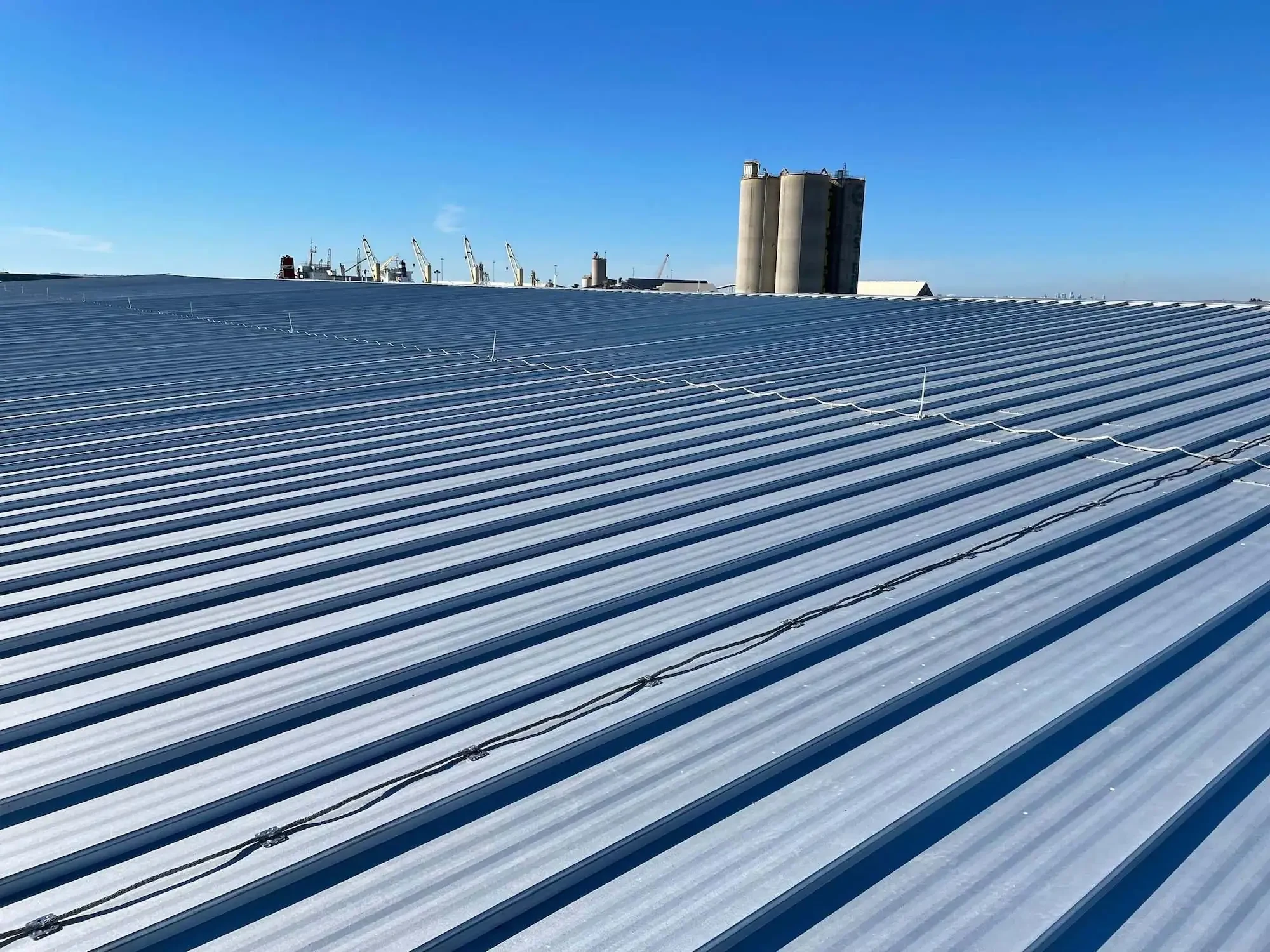
Standing seam metal roofing shows up on the buildings in this market where appearance matters as much as performance: schools, municipal buildings, and the hospitality and mixed-use development around Titletown and Lambeau Field. We install and maintain concealed-fastener standing seam systems built for real snow load and real curb appeal both.
Snap-Lock vs Mechanically Seamed Panels
Snap-lock panels click together without specialized tooling, which keeps install labor down and works well on roofs with moderate slope and standard wind exposure. Mechanically seamed panels require a seaming machine to fold the panel edges together into a tighter, more weathertight joint, and we spec that method on steeper roofs, roofs with lower slope than typical, or buildings facing higher wind exposure near the open bay.
The choice between the two is a performance decision tied to roof geometry and site exposure, not a budget shortcut. We walk owners through which panel type the roof's actual slope and wind zone call for before pricing either option.
Snow Shedding on Steep-Slope Metal Roofs
Metal's smooth surface sheds snow far more readily than a low-slope membrane roof, which is a real advantage on steep-slope applications around Titletown and the district's hospitality buildings, but it comes with a tradeoff: snow and ice sliding off a metal roof can be a hazard at entrances and walkways below. Snow guards and retention systems get specified at those locations as part of the original design, not added after the first complaint.
On schools and municipal buildings with equipment or walkways at lower roof levels, we map where sliding snow will land before finalizing the panel layout and retention system placement.
Thermal Movement and Floating Clip Systems
Metal panels expand and contract with temperature swings more than membrane roofing does, and a standing seam roof spanning a full Wisconsin temperature range needs clips that let the panel float slightly rather than locking it rigidly to the deck. A fixed-point clip system anchors the panel at one location while floating clips elsewhere accommodate the rest of the panel's movement, which prevents the oil-canning and fastener stress that shows up on roofs where thermal movement was not designed for.
What a Standing Seam Installation Includes
- Panel and seam type selection matched to roof slope and wind exposure
- Underlayment specified for the building's condensation and ice-dam risk
- Fixed-point and floating clip layout designed for thermal movement
- Snow guard and retention system placement at entrances and walkways
- Concealed-fastener detail work at ridges, valleys, and penetrations
- Flashing continuity checked at every roof-to-wall transition
Where Standing Seam Fits in This Market
Beyond Titletown, we install and service standing seam roofs on schools and municipal buildings where a fifty-year-plus expected service life and low ongoing maintenance make the higher install cost worth it over the building's life, and on office and hospitality projects where the architectural profile of a standing seam roof is part of the design itself as much as a functional choice.
Concealed Fasteners and Long-Term Leak Points
The concealed-fastener design is the main reason standing seam outperforms exposed-fastener metal roofing on leak resistance over time, since there are no exposed screw penetrations through the panel field for a gasket to eventually fail on. The leak points that do develop on standing seam roofs concentrate at ridge caps, valleys, and wall transitions, which is why we put extra inspection attention on those details rather than the open panel field.
Panel Gauge and Coating Systems
Panel gauge affects both the roof's resistance to hail and dropped-tool punctures and its tendency toward oil-canning on long, flat runs. We spec gauge against the specific building's exposure and roof geometry rather than defaulting to the thinnest gauge a manufacturer offers just to hit a lower number on the estimate.
Factory-applied paint systems, typically a fluoropolymer or polyester coating baked onto the panel before it ever reaches the roof, are what hold color and chalk resistance over decades of UV exposure. We compare coating warranty terms across manufacturers the same way we compare membrane warranties on a low-slope roof, since the panel substrate and the paint system carry separate warranty coverage.
Standing Seam Metal Roofing Questions
How does standing seam compare in cost to a single-ply membrane?
Installed cost per square foot typically runs higher than TPO or EPDM, but the expected service life is also considerably longer, which changes the lifecycle cost comparison depending on how long the owner plans to hold the building.
Can standing seam be installed over an existing low-slope membrane roof?
Sometimes, as a retrofit assembly with a structural sub-framing system, but that depends on the existing roof's slope and the building's structural capacity to carry the new system.
Does snow sliding off a metal roof damage gutters or landscaping below?
It can, which is why snow guards and retention systems get specified at the design stage rather than added reactively after a season of watching where the snow lands.
How often does a standing seam roof need maintenance?
Far less than a membrane roof. Annual inspection of seams, flashings, and fastener points at fixed-clip locations is typically sufficient, since there is no membrane surface degrading under UV exposure the way a single-ply roof does.
What causes oil-canning on a standing seam panel?
Usually a combination of panel gauge, substrate flatness, and inadequate allowance for thermal movement during install. A properly designed floating clip system reduces but does not entirely eliminate the visual effect on very flat panel runs.