
Roof Systems
SBS Modified Bitumen Roofing in Green Bay, WI
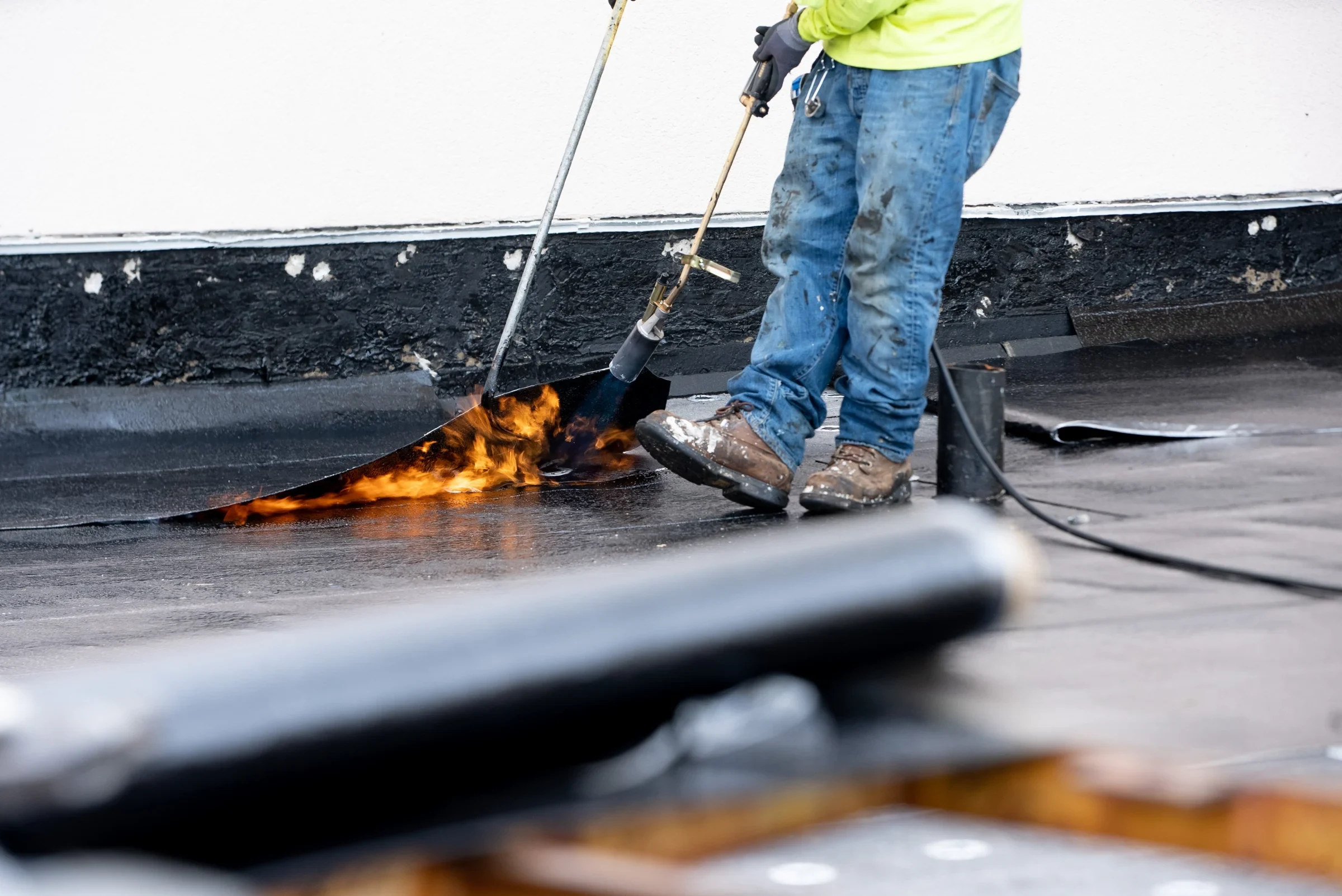
SBS Modified Bitumen for Green Bay's Asphalt-Era Building Stock
SBS modified bitumen is a rubberized-asphalt membrane, and it is still the right call on a lot of the older paper mill and industrial buildings around Green Bay where a multi-ply, self-flashing system fits both the existing roof profile and the owner's tolerance for risk.
Matching New Roofing to Old Construction Along the Fox River
A lot of the industrial buildings near the mills along the Fox River corridor were originally built up with asphalt roofing, and when those roofs reach end of life, modified bitumen is often the most direct match to the existing deck, insulation, and flashing details already in place. Switching to a single-ply system on that kind of building sometimes means redoing more of the roof edge and flashing detail than staying with a bitumen-based system would.
SBS rubberized asphalt gives that older asphalt-based approach real flexibility that traditional built-up roofing never had, which is why we treat SBS mod bit as a meaningfully better system than a straight asphalt built-up roof, not simply a modern label for the same idea.
On a downtown building with a mix of low-slope sections and older parapet detailing, we often find mod bit's self-flashing capability at those transitions saves labor hours a single-ply crew would spend building out separate flashing pieces from scratch.
Two Plies Instead of One: Redundancy Under Snow and Ice Load
A base sheet plus a cap sheet gives the roof two independent waterproofing layers instead of one, which matters on buildings carrying heavy snow load where the roof takes on more mechanical stress from drift, ice buildup, and the weight of snow removal equipment when it gets used. If the cap sheet is damaged, the base sheet is still there as a backup layer rather than exposed deck.
That redundancy is part of why we still recommend SBS mod bit on some heavy-industrial roofs even though it costs more in labor to install than a single-ply membrane. On a roof that will see foot traffic, ice removal, and decades of freeze-thaw cycling, the second layer is doing real work rather than sitting there as marketing.
What the Rubber Modifier Actually Buys You in Cold Weather
The styrene-butadiene-styrene rubber compounded into the asphalt keeps the sheet flexible at low temperatures far better than straight asphalt did, which is the core reason SBS mod bit holds up through a Wisconsin winter better than older built-up roofing. Cold-weather cracking at seams and flashings, the classic built-up roof failure mode here, is significantly reduced with SBS.
We still check membrane flexibility ratings against the specific product being specified, since not every SBS formulation performs identically at low temperature, and a product rated for a milder climate is not automatically the right choice for a Green Bay winter.
Choosing an Application Method Against Fire Code and Site Access
Application method matters as much as the membrane itself in freeze-thaw performance. Torch-applied, hot-mopped, cold-adhesive, and self-adhered SBS systems all perform slightly differently at seams, and we match the application method to the building's fire code restrictions and the crew's site conditions before specifying one.
Asphalt-based membranes can also be softened by certain organic solvents, so mod bit is not automatically the right call on a roof sitting directly under active chemical exhaust discharge. Where exposure is limited to steam and general industrial moisture, which is the more common condition around the paper and packaging operations here, SBS holds up fine over a normal service life.
- Match application method (torch, hot-mop, cold-adhesive, self-adhered) to fire code and site conditions
- Verify base and cap sheet compatibility with existing deck and insulation
- Confirm structural capacity for multi-ply system weight before recover
- Check flashing detail continuity at every parapet and penetration
- Document any chemical exhaust exposure before finalizing the spec
- Compare low-temperature flexibility ratings across candidate SBS products
Coordinating Mod Bit Recovers With an Active Industrial Operation
A mill or plant roof is rarely down for maintenance while the recover is happening, which changes how we sequence a modified bitumen project compared to a vacant or lightly used building. Torch work near active production areas has to be coordinated with the site's fire watch procedures and, in some cases, scheduled around specific process shutdowns rather than a standard construction calendar.
We phase these projects in sections where the roof plan allows it, closing in each completed section before moving to the next rather than opening the entire roof at once on a building that cannot tolerate an extended exposed-deck period.
That phased approach adds coordination time up front, but it is the difference between a mod bit recover that finishes without an interior water event and one that does not, on a building where the ground floor below is running production the whole time.
Modified Bitumen Questions on Older Buildings
Is modified bitumen outdated compared to single-ply?
It is a mature technology, not an obsolete one. On buildings originally built with asphalt roofing, it is often the most practical and cost-effective match to existing conditions.
Does SBS mod bit need to be torched down?
Not always. Self-adhered and cold-adhesive application methods are common alternatives where torch application is restricted by fire code or site conditions.
How does mod bit compare to TPO on cost?
Material and labor combined often land close to mid-range single-ply pricing, though torch-applied systems can run higher due to the multi-ply labor involved.
Can mod bit be coated to extend service life?
Yes, a reflective coating over a sound mod bit cap sheet is a common way to extend service life and add reflectivity without a full tear-off.
Why does redundancy matter more here than in a mild climate?
More freeze-thaw cycles per year mean more stress events on the membrane over its service life, so a backup waterproofing layer has more chances to matter here than in a climate with fewer temperature swings.