Commercial Roofing Services
EPDM Commercial Roofing in Green Bay, WI
EPDM Rubber Roofing Installed and Repaired Across the Green Bay Area
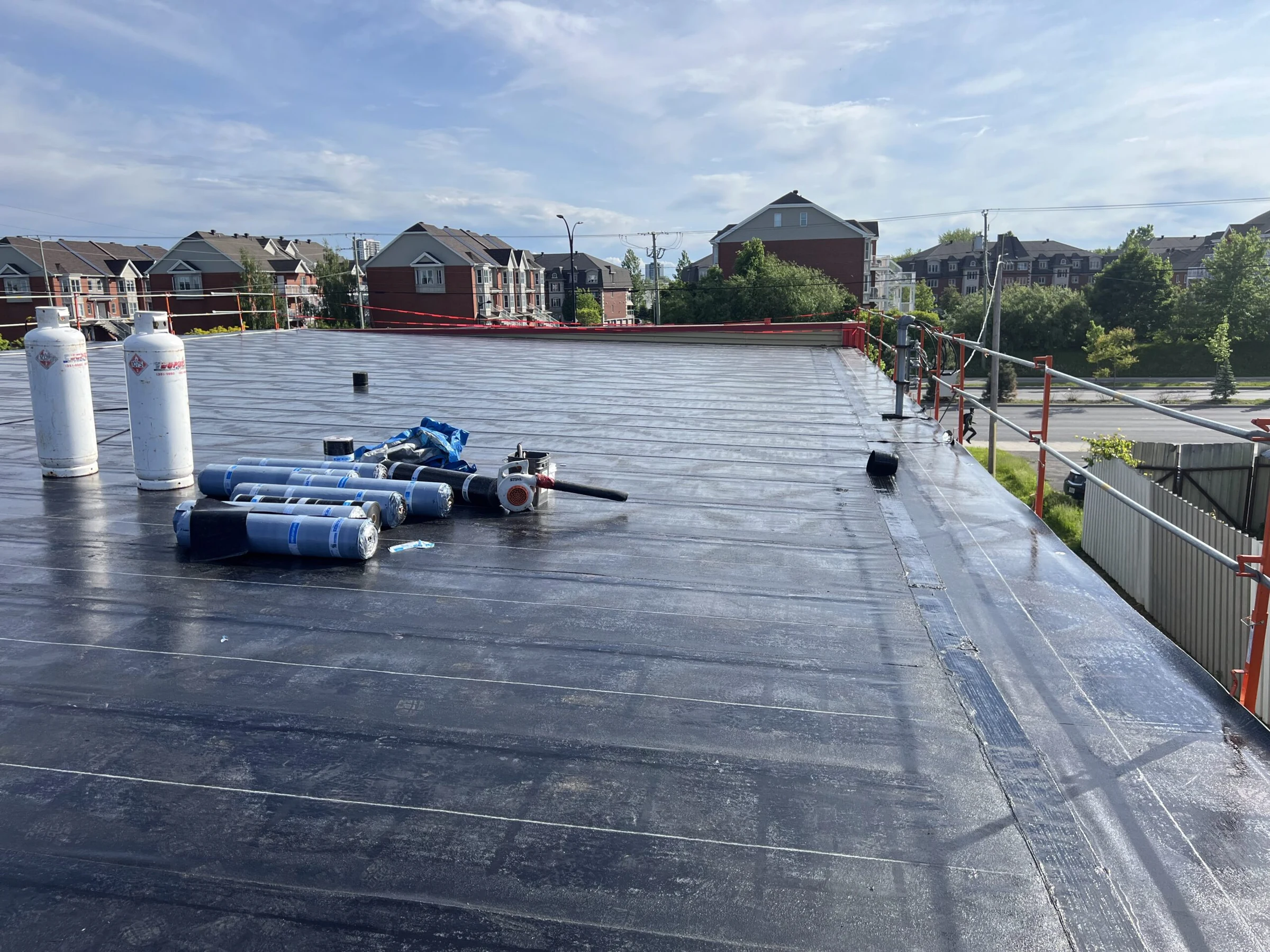
Black EPDM rubber has been the standard low-slope membrane on Wisconsin industrial buildings for decades, and it still earns a place on our spec sheet where thermal cycling resistance and material cost matter more than heat-welding speed. We install new EPDM systems and repair the ones already on roofs across De Pere, Howard, and the older industrial stock near downtown.
Why Rubber Still Gets Specified Here
EPDM is a synthetic rubber sheet, and rubber stays flexible at low temperatures better than most single-ply plastics. On a roof that swings from single digits in January to a 40-degree thaw the same week, that flexibility means fewer stress cracks at corners and penetrations over the membrane's service life. Material cost per square foot typically runs below TPO and well below PVC, which keeps EPDM in the mix on large, simple roof planes.
Distribution buildings and light manufacturing shells with straightforward geometry and few penetrations are the cleanest fit. Where a roof has heavy detail work around curbs and equipment, the labor savings of EPDM's simpler field membrane get eaten up by seam work at every one of those details.
Seam Work Is Where EPDM Installations Succeed or Fail
Unlike TPO or PVC, EPDM seams are bonded with tape or liquid adhesive rather than heat-welded, and that seam is the part of the system most likely to fail first if it is rushed. A tape seam installed outside its application temperature window, or one that was not rolled with full, even pressure at the time of install, is where nearly every leak call on an older EPDM roof traces back to.
We treat seam work as the part of an EPDM install that gets the most attention, not the field membrane rollout. Surface prep, primer application, and roller pressure at every lap get checked and documented before we move to the next section of roof.
Attachment Methods: Ballasted, Mechanically Fastened, or Fully Adhered
Ballasted EPDM, held down with river rock or paver ballast instead of fasteners or adhesive, is the lowest-cost attachment method but adds real dead load to the roof, so we check structural capacity before recommending it on an older building. Mechanically fastened EPDM avoids that weight but needs a fastening pattern set to the building's actual wind exposure, especially close to the open bay where wind loading runs higher than inland.
Fully adhered EPDM costs more in labor but gives the cleanest membrane surface for a roof with regular foot traffic, since there is nothing loose or exposed for a technician to trip over walking between rooftop units.
What an EPDM Installation Includes
- Deck inspection and moisture scan before any recover decision
- Insulation sized to current code and the building's snow load requirements
- EPDM membrane in the attachment method matched to wind exposure and traffic
- Taped or liquid-adhered seams with full roller pressure at every lap
- Mechanically secured flashing at parapets and curbs, not adhesive-only
- Post-install seam probe and documentation for the ownership file
- Manufacturer field inspection ahead of warranty issuance
Repairing an EPDM Roof Someone Else Installed
Most of our EPDM repair calls come from roofs we did not originally install. We start those the same way regardless of who did the original work: probe every seam and T-joint before deciding whether a targeted seam and flashing repair makes sense or whether the field membrane itself has degraded past the point repair can fix.
Ponding water sitting against a seam through repeated freeze-thaw cycles is one of the fastest ways an otherwise sound lap opens up. On repair calls we check tapered insulation and drain placement even when the leak looks like a seam problem on the surface, because slope and drainage are often the real cause.
Black EPDM Near Paper and Packaging Operations
Older industrial buildings around De Pere and the mills along the Fox River were often roofed in EPDM decades ago, and a lot of what we do on that stock today is targeted seam and flashing rehabilitation rather than full replacement. Where the field membrane is still sound and only the seams or flashings have aged out, that approach stretches the roof's useful life at a fraction of reroof cost.
We draw a clear line between that kind of repair and a genuine replace decision. If the field membrane itself has gone brittle or lost significant thickness to UV exposure, chasing seam failures year after year usually costs more in total than a planned reroof would have.
EPDM Installation and Repair Questions
How long does an EPDM roof typically last in this climate?
With sound seam work and routine maintenance, EPDM roofs here commonly reach 20 to 25 years before full replacement is warranted. Seam quality at install is the single biggest factor in that outcome, more than the membrane itself.
Is EPDM cheaper than TPO to install?
Material cost is usually lower, but labor on seam-intensive roofs can close that gap. We price both systems for a specific roof rather than assuming EPDM automatically comes in cheaper.
Can an existing EPDM roof be coated instead of replaced?
Often yes, if the membrane is clean, dry, and the seams check out sound during inspection. A silicone coating can extend service life on a sound EPDM substrate at a fraction of replacement cost.
Why do EPDM roofs seem to leak more at seams than at the field membrane?
Because the seams are the one part of the system relying on adhesive bonding rather than the membrane's own material strength. A well-installed seam holds up for decades, but it is more sensitive to installation conditions than the field sheet itself.
Does ballasted EPDM work on every roof?
No. The added weight from ballast requires structural capacity we check before recommending it, and it is generally not our first choice on older buildings without a structural review confirming the roof can carry it.